
Tower Fire provides professional fire door inspections, installation, repairs and remedial works for commercial and residential buildings across the UK. Delivered by experienced former fire service professionals, our services help you achieve fire door compliance and protect lives, property and business continuity.
Fire Doors:
Installation, Inspections and Compliance from Tower Fire
Tower Fire provides fire door installation, fire door inspections, fire door surveys and remedial repairs for commercial, residential and public sector buildings across the UK. Every fire doorset is correctly specified, professionally installed to BS 8214, and fully certified, while our experienced former fire service professionals carry out detailed inspections to identify defects that could compromise your building’s fire compartmentation.
Under the Regulatory Reform (Fire Safety) Order 2005, Responsible Persons have a legal duty to ensure fire doors are maintained in efficient working order. Damaged, poorly fitted or non-compliant fire doors can allow fire and smoke to spread rapidly, putting lives, property and business continuity at risk. Tower Fire helps you maintain compliance, protect occupants and ensure your fire doors perform when they are needed most.
What Is a Fire Door?
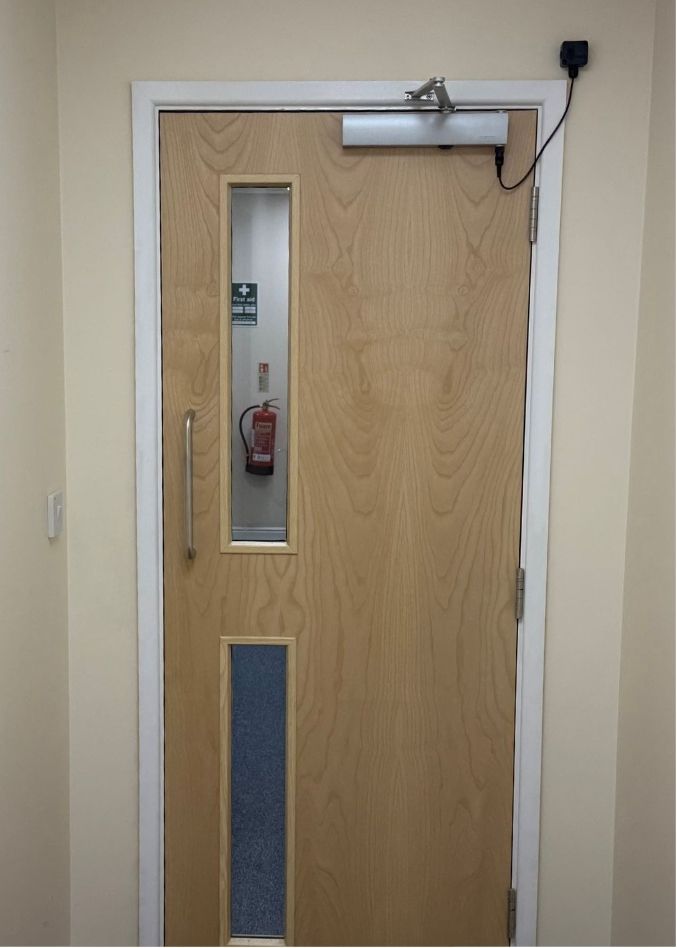
A fire door is a specially designed and tested doorset that helps prevent the spread of fire and smoke, protecting escape routes and giving occupants more time to evacuate safely. A compliant fire door is made up of the door leaf, frame, intumescent and smoke seals, glazing, hinges, self-closing device and ironmongery, all of which must be correctly specified, installed and tested to work together as a complete fire-resisting system. Replacing or altering any component with a non-certified alternative can compromise the fire door’s performance and invalidate its certification.
Fire doors are classified by the length of time they can resist fire. FD30 fire doors provide up to 30 minutes of fire resistance, while FD60 fire doors provide up to 60 minutes. Doors marked FD30S or FD60S also include cold smoke seals, which help prevent the spread of smoke during the early stages of a fire. The correct fire door specification depends on your building’s fire strategy, compartmentation design and fire risk assessment. Regular fire door inspections are essential to ensure every fire door continues to perform as intended and remains compliant with the Regulatory Reform (Fire Safety) Order 2005.
Legal Requirements for Fire Doors in the UK
Fire doors are a legal requirement in most non-domestic and multi-occupied residential buildings across the UK. Under the Regulatory Reform (Fire Safety) Order 2005 (RRFSO), the Responsible Person must ensure fire doors are correctly installed, regularly inspected and maintained in efficient working order to prevent the spread of fire and smoke and protect occupants.
Key legislation and guidance includes:
Failure to maintain compliant fire doors can lead to enforcement action, prosecution, invalidated insurance and increased risk to life. Regular fire door inspections, remedial repairs and professional installation are essential to maintaining effective fire compartmentation and meeting your legal responsibilities.
Our Fire Door Installation and Inspection Service
Tower Fire provides a complete fire door installation UK and inspection service from initial fire door survey UK and specification through to ongoing maintenance and certification.
Supply
FD30 and FD60 doorsets for commercial, residential, healthcare, educational, and industrial premises, specified for the required fire resistance rating and building type
Installation
BS 8214-compliant installation by qualified engineers, with full documentation and installation certificates for every doorset fitted
Inspection
our fire door inspection UK service delivers six-monthly professional inspections covering self-closer performance, intumescent and smoke seal condition, gap tolerances, glazing integrity, ironmongery, certification label presence, and frame and threshold condition
Maintenance, remedial works, and replacement
replacement of seals, closers, and hardware to restore fire door compliance. Where the door leaf or frame is beyond repair, we provide full fire door replacement UK supply and installation under the same contract
Certification
full written inspection reports and installation certificates provided after every engagement, suitable for building owner records and enforcement inspection
What Is Checked During a Fire Door Inspection?
Regular fire door inspections are essential to ensure your fire doors remain compliant, protect escape routes and perform correctly in the event of a fire. During every fire door survey, Tower Fire’s experienced inspectors assess the complete doorset to identify defects that could compromise fire resistance or prevent the door from operating as intended.
Every inspection includes:
- Self-closing device: Checking the fire door closes fully from any open position and latches securely without manual assistance.
- Intumescent and smoke seals: Inspecting seals for damage, gaps, paint contamination or missing sections that could allow fire or smoke to spread.
- Door gaps and clearances: Measuring the gaps around the door leaf to ensure they comply with BS 8214 and manufacturer tolerances.
- Certification: Confirming the fire door certification label is present, legible and appropriate for its location and required fire resistance rating.
- Fire-rated glazing: Checking glass panels, glazing beads and intumescent glazing seals for damage, movement or deterioration.
- Ironmongery and hardware: Inspecting hinges, locks, latches, closers, handles and hold-open devices to ensure they are correctly specified, secure and fully operational.
- Door frame and threshold: Examining the frame, architraves and threshold for damage, movement, unauthorised alterations or gaps that could reduce the fire door’s performance.
Following every inspection, Tower Fire provides a detailed report with photographs, compliance findings and prioritised recommendations, helping you identify defects, plan remedial works and demonstrate compliance with the Regulatory Reform (Fire Safety) Order 2005.

Why Choose Tower Fire for Fire Door Services?
Choosing the right fire door contractor is about more than compliance—it’s about protecting lives, property and your legal responsibilities. At Tower Fire, every fire door inspection, installation and remedial repair is delivered by experienced former fire service professionals who understand how fire and smoke spread through buildings and the critical role compliant fire doors play in protecting occupants.Why organisations across the UK choose Tower Fire: Whether you need a fire door survey, new fire door installation, remedial repairs or ongoing maintenance, Tower Fire provides practical, compliant solutions that help protect your building and give you confidence that your fire doors will perform when they are needed most.
back to you as soon as possible!